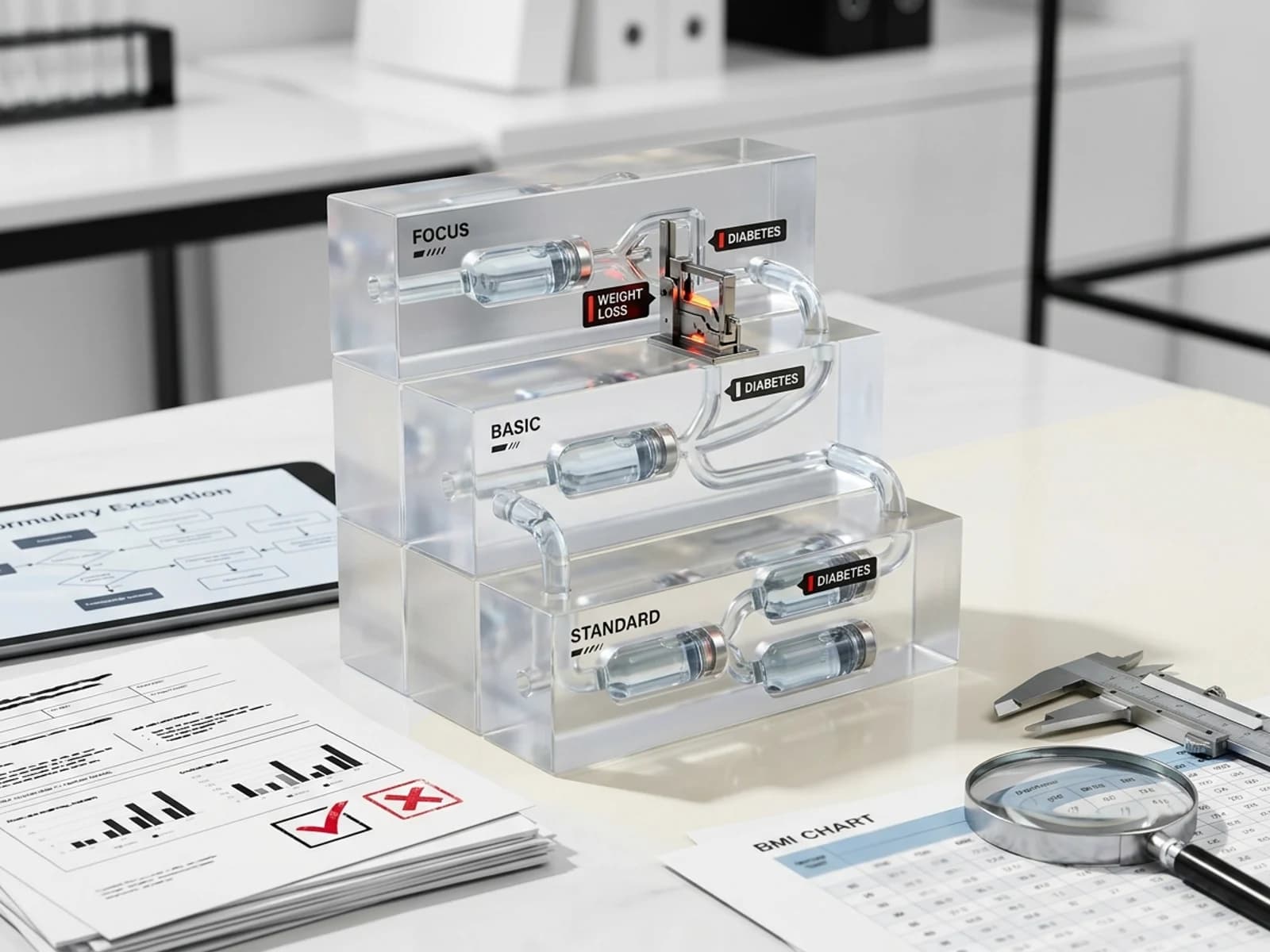
The Blue Cross and Blue Shield Federal Employee Program (FEP) is the largest federally sponsored health plan in the United States, covering approximately 5.5 million federal employees, retirees, and family members through the Federal Employees Health Benefits (FEHB) program and the Postal Service Health Benefits (PSHB) program. FEP operates three plan tiers — FEP Blue Focus, FEP Blue Basic, and FEP Blue Standard — each with different formulary rules, drug tier placement, and cost-sharing for GLP-1 receptor agonists.
In 2026, FEP updated its GLP-1 coverage policies significantly: weight-loss GLP-1s (Wegovy, Saxenda, Zepbound) now require a formulary exception request rather than standard prior authorization, and tier placement varies by plan. Diabetes-indicated GLP-1s (Ozempic, Mounjaro, Rybelsus, Trulicity) are covered under the standard formulary with PA. This guide maps each FEP plan's GLP-1 rules, details the formulary exception and PA criteria, and explains the appeal process. It is independent information and not medical advice or reimbursement guidance for a specific patient or plan.
Quick answer
| GLP-1 Drug | FEP Blue Focus | FEP Blue Basic | FEP Blue Standard |
|---|---|---|---|
| Ozempic | Covered (incretin mimetic class), PA | Covered, PA | Covered, PA |
| Mounjaro | Covered, PA | Covered, PA | Covered, PA |
| Rybelsus | Covered, PA | Covered, PA | Covered, PA |
| Trulicity | Covered, PA | Covered, PA | Covered, PA |
| Wegovy | Tier 2 preferred (with formulary exception) | Excluded — requires formulary exception | Excluded — requires formulary exception |
| Zepbound | Tier 2 preferred (with formulary exception) | Tier 3 non-preferred (with formulary exception) | Tier 3 non-preferred (with formulary exception) |
| Saxenda | Tier 3 (with formulary exception) | Tier 3 (with formulary exception) | Tier 3 (with formulary exception) |
PA = prior authorization. Tier placement shown applies after a formulary exception is approved for weight-loss GLP-1s. Diabetes GLP-1s are listed on the formulary under the incretin mimetic agent class.
FEP plan structure and GLP-1 access
FEP Blue Focus
FEP Blue Focus is the lowest-premium plan with a two-tier pharmacy benefit (generic and brand). Key features for GLP-1s:
Two drug tiers only: Tier 1 (generic) and Tier 2 (brand). All GLP-1s are Tier 2 brand drugs.
Wegovy and Zepbound: If a formulary exception is approved, both are placed at Tier 2 (Preferred) on FEP Blue Focus — the most favorable tier placement of any FEP plan.
Lower premiums but higher cost-sharing at the pharmacy counter relative to Basic and Standard for some services.
Annual pharmacy out-of-pocket maximum: $2,100 per member for 2026.
FEP Blue Basic
FEP Blue Basic is the mid-tier plan with a five-tier pharmacy benefit:
Five drug tiers: Generics, Preferred Brand, Non-Preferred Brand, Preferred Specialty, Non-Preferred Specialty.
Wegovy: Not covered on Basic — requires a formulary exception. If approved, tier placement depends on the drug.
Zepbound: Tier 3 (Non-Preferred Brand) if formulary exception is approved.
Annual pharmacy OOP max: $2,100 per member for 2026.
FEP Blue Standard
FEP Blue Standard is the highest-premium plan with the broadest benefit:
Five drug tiers: Same structure as Basic.
Wegovy: Listed at Tier 3 on the 2026 abbreviated formulary (marked with ◊ for prior approval), but weight-loss indication requires a formulary exception.
Zepbound: Tier 3 (Non-Preferred Brand) if formulary exception is approved.
Annual pharmacy OOP max: $2,100 per member for 2026.
FEP Medicare Prescription Drug Program (MPDP)
For federal retirees enrolled in both Medicare and FEP, the MPDP is a standalone Part D plan. GLP-1 coverage under MPDP follows Medicare rules:
T2D GLP-1s: Covered under Part D with PA.
Weight-loss GLP-1s: Generally excluded under Medicare's longstanding prohibition on weight-loss drug coverage.
CMS demonstration (July 2026): A new CMS program launching July 1, 2026, may allow qualifying Medicare beneficiaries to access GLP-1 drugs for $50/month for obesity treatment, subject to eligibility criteria and PA requirements. FEP MPDP members should check with FEP for participation details.
Weight-loss GLP-1 formulary exception criteria
Unlike diabetes-indicated GLP-1s (which are on the FEP formulary under the incretin mimetic class), weight-loss GLP-1s (Wegovy, Zepbound, Saxenda) are listed on the abbreviated formulary under the "Anti-Obesity" class but require a formulary exception for coverage.
FEP Weight Loss Medications policy (5.99.027, effective January 1, 2026)
The FEP clinical policy for weight-loss medications applies to all three plans. Key criteria:
Initial authorization requirements
Diagnosis: Chronic weight management
BMI threshold (age 18+):
BMI ≥ 30 kg/m², OR
BMI ≥ 27 kg/m² with at least one weight-related comorbidity (hypertension, type 2 diabetes mellitus, dyslipidemia)
BMI threshold (age 12–17):
BMI ≥ 95th percentile for age and sex
Additional requirements:
Patient has participated in a comprehensive weight management program
Medication will be used in combination with lifestyle changes and reduced-calorie diet
No dual GLP-1 therapy (no concurrent use of other GLP-1 receptor agonists such as Mounjaro, Rybelsus, Soliqua, Xultophy)
Zepbound specifically: Effective January 2026, FEP moved Zepbound to its own policy (5.99.031). Current criteria require trial of at least two oral weight-management medications (e.g., phentermine, Qsymia) and trial of preferred product(s) per the FEP formulary appendix, unless a valid medical exception exists (inadequate treatment response, intolerance, or contraindication). The prior policy (5.99.027, through December 2024) had required trial of both Saxenda AND Wegovy before Zepbound.
No dual therapy with another PA medication for weight loss
Wegovy for cardiovascular disease (additional pathway):
Patient has established cardiovascular disease (congenital heart disease, cerebrovascular disease, peripheral artery disease, coronary heart disease, acute coronary syndrome, myocardial infarction, unstable angina, prior PCI/CABG)
Patient has at least one weight-related comorbid condition (T2D, dyslipidemia, hypertension)
Reauthorization criteria
Continued documentation of lifestyle modification participation
No dual GLP-1 therapy
For Zepbound: continued trial compliance with step therapy requirements
Quantity limits
| Medication | Quantity Limit |
|---|---|
| Wegovy | Per formulary (typically 4 syringes per 28 days) |
| Saxenda | Per formulary |
| Zepbound | Per formulary (typically 4 syringes per 28 days) |
| Contrave | 360 tablets per 90 days |
| Qsymia | Per formulary |
How the formulary exception process works
FEP's formulary exception process for weight-loss GLP-1s differs from standard PA:
Provider submits a formulary exception request — not a standard PA form. Use the FEP Traditional Formulary Exception Form (for Traditional FEHB & PSHB) or the FEP MPDP Formulary Exception Form (for MPDP FEHB & PSHB).
Provider can also call:
Traditional FEHB & PSHB: 1-877-727-3784
MPDP FEHB & PSHB: 1-855-344-0930
Provider can request the formulary criteria to understand exact requirements before submitting.
Important: Even if the formulary exception is approved, you cannot request a tier exception. The drug will be placed at the tier assigned to your specific FEP plan.
Diabetes GLP-1 prior authorization criteria
FEP Antidiabetic GLP-1, GIP-GLP-1 Agonists policy (5.30.086, effective July 1, 2025)
For Ozempic, Mounjaro, Rybelsus, Trulicity, Victoza, Byetta, Bydureon, and Adlyxin:
Prior-approval requirements
Diagnosis: Type 2 diabetes mellitus
Documented T2D with at least one of:
HbA1c ≥ 6.5%
Fasting plasma glucose ≥ 126 mg/dL
2-hour glucose ≥ 200 mg/dL during OGTT
History of symptoms of hyperglycemia (polyuria, polydipsia, polyphagia) with casual plasma glucose ≥ 200 mg/dL
May be considered medically necessary when diagnosis and criteria are met; investigational for all other indications.
Quantity limits
| Medication | Quantity Limit | Duration |
|---|---|---|
| Mounjaro | 12 units per 84 days | 12 months |
| Ozempic | 3 pens per 84 days | 12 months |
| Rybelsus | 90 tablets per 90 days | 12 months |
| Trulicity | 12 units per 84 days | 12 months |
| Victoza | 9 units per 90 days | 12 months |
| Adlyxin (formulary exception only) | 6 units per 84 days | 12 months |
| Bydureon/Bydureon BCise (formulary exception only) | 12 units per 84 days | 12 months |
| Byetta (formulary exception only) | 3 units per 90 days | 12 months |
PA for specific diabetes GLP-1 formulations applies only to formulary exceptions due to being a non-covered medication. Most diabetes GLP-1s are on the FEP formulary without a separate formulary exception.
Cost-sharing by plan (2026)
Traditional pharmacy benefit (retail and mail service)
| Benefit | FEP Blue Focus | FEP Blue Basic | FEP Blue Standard |
|---|---|---|---|
| Retail Tier 1 (Generic) | Copay per formulary | $10 copay | $5 copay |
| Retail Tier 2 (Preferred Brand) | Copay per formulary | $45 copay | $35 copay |
| Retail Tier 3 (Non-Preferred Brand) | — | 50% coinsurance | 50% coinsurance |
| Mail Service Preferred Brand | 15% coinsurance | $95 copay | $85 copay |
| Mail Service Non-Preferred Brand | 15% coinsurance | $125 copay | $125 copay |
| Specialty (Preferred) | — | $100 copay (30-day) | $100 copay (30-day) |
| Specialty (Non-Preferred) | — | $150 copay (30-day) | $150 copay (30-day) |
| Annual pharmacy OOP max | $2,100 | $2,100 | $2,100 |
MPDP benefit (Medicare retirees)
| Benefit | FEP Blue Basic with MPDP | FEP Blue Standard with MPDP |
|---|---|---|
| Retail Generics | $10 copay | $5 copay |
| Retail Preferred Brand | $45 copay | $35 copay |
| Retail Non-Preferred Brand | 50% coinsurance | 50% coinsurance |
| Retail Specialty | $75 copay | $60 copay |
| Mail Service Preferred Brand | $95 copay | $85 copay |
| Mail Service Specialty | $150 copay | $150 copay |
OPM requirement and plan-specific differences
The U.S. Office of Personnel Management (OPM) requires each FEHB plan to cover at least one GLP-1 medication prescribed for weight loss. In 2023, OPM issued a carrier letter directing plans to cover at least one GLP-1 weight-loss drug and to annually evaluate coverage as new drugs receive FDA approval. However, OPM does not require plans to cover all GLP-1s. Key differences among FEP plans:
BCBS FEP covers Wegovy on Basic and Standard plans (Tier 3 with formulary exception). Zepbound requires its own formulary exception under policy 5.99.031, with step therapy through oral weight-management medications and preferred GLP-1 products.
FEP Blue Focus covers both Wegovy and Zepbound at Tier 2 (Preferred) when a formulary exception is approved — the most favorable placement.
FEP does not allow tier exceptions — even if your formulary exception is approved, the drug's tier assignment cannot be changed through a separate tier exception request.
Generic liraglutide (Victoza/Saxenda): For FEP Blue Basic members seeking a lower-cost option, generic liraglutide is often Tier 1 with a copay as low as $15/month. While it is a daily injection rather than weekly and may be less effective than semaglutide or tirzepatide, it provides a substantially more affordable pathway when Wegovy or Zepbound are Tier 3.
OPM's mandate extends to any Part D or Medicare Advantage plan offered by an FEHB carrier, meaning federal annuitants enrolled in EGWP plans also have GLP-1 coverage access.
Common denial reasons and appeal steps
Common denials for weight-loss GLP-1s
Formulary exception denied — criteria not met (BMI, comorbidity, lifestyle modification, step therapy).
Step therapy not completed — for Zepbound, the requirement to try oral weight-management medications (and preferred products per the FEP formulary) first was not documented.
Missing lifestyle modification records — no evidence of comprehensive weight management program participation.
BMI below threshold — documented BMI under 30 without qualifying comorbidity, or under 27 with comorbidity.
Dual GLP-1 therapy — patient is currently on a diabetes GLP-1 (Ozempic, Mounjaro) and requesting Wegovy simultaneously.
Cardiovascular pathway not documented — for Wegovy prescribed under the CVD indication, established cardiovascular disease was not adequately documented.
Appeal workflow
Request the specific denial reason in writing from FEP.
Prescriber submits appeal with letter of medical necessity and supporting documentation (BMI measurement, labs, lifestyle program records, sleep study results if applicable, cardiovascular records).
Peer-to-peer review — prescriber can request direct conversation with FEP medical reviewer.
Second-level appeal — available if the first appeal is denied.
OPM review — as a federal employee health plan, FEP denials can ultimately be escalated to OPM for independent review.
Key contacts
FEP Customer Care: 1-800-624-5060 (TTY: 711)
FEP Formulary Exception (Traditional FEHB & PSHB): 1-877-727-3784
FEP MPDP Formulary Exception: 1-855-344-0930
FEP Formulary and Drug Lists: fepblue.org/pharmacy/prescriptions
FEP Weight Management Resources: fepblue.org/manage-your-health/managing-specific-conditions/weight
Sources
FEP Blue 2026 Abbreviated Formulary Booklet, effective January 1, 2026. Blue Cross and Blue Shield Association. Available at: fepblue.org
FEP Weight Loss Medications policy 5.99.027, effective January 1, 2026. Blue Cross and Blue Shield Association. Available at: fepblue.org
FEP Zepbound (tirzepatide) policy 5.99.031, effective January 1, 2026. Blue Cross and Blue Shield Association. Available at: fepblue.org
FEP Antidiabetic GLP-1, GIP-GLP-1 Agonists policy 5.30.086, effective July 1, 2025. Blue Cross and Blue Shield Association. Available at: fepblue.org
FEP Pharmacy FAQ, 2026. Available at: fepblue.org/faqs/faq-pharmacy
FEP What's New for 2026. Available at: fepblue.org/open-season/whats-new-2026
FEP Blue Focus 2026 Brochure (CS 1039PS), Office of Personnel Management. Available at: opm.gov
FEP Medicare Prescription Drug Program (MPDP) Summary of Benefits, 2026. Available at: fepblue.org/medicarerx
Government Executive: "More GLP-1 options are coming for federal retirees, but they come with a catch," May 2026. Available at: govexec.com
ASGE: "Medicare GLP-1 Program Begins July 1," May 14, 2026. Available at: asge.org
Centers for Medicare & Medicaid Services (CMS): Medicare GLP-1 Drug Demonstration Program for Obesity Treatment, 2026. Available at: https://www.cms.gov/newsroom/fact-sheets/medicare-drug-price-negotiation