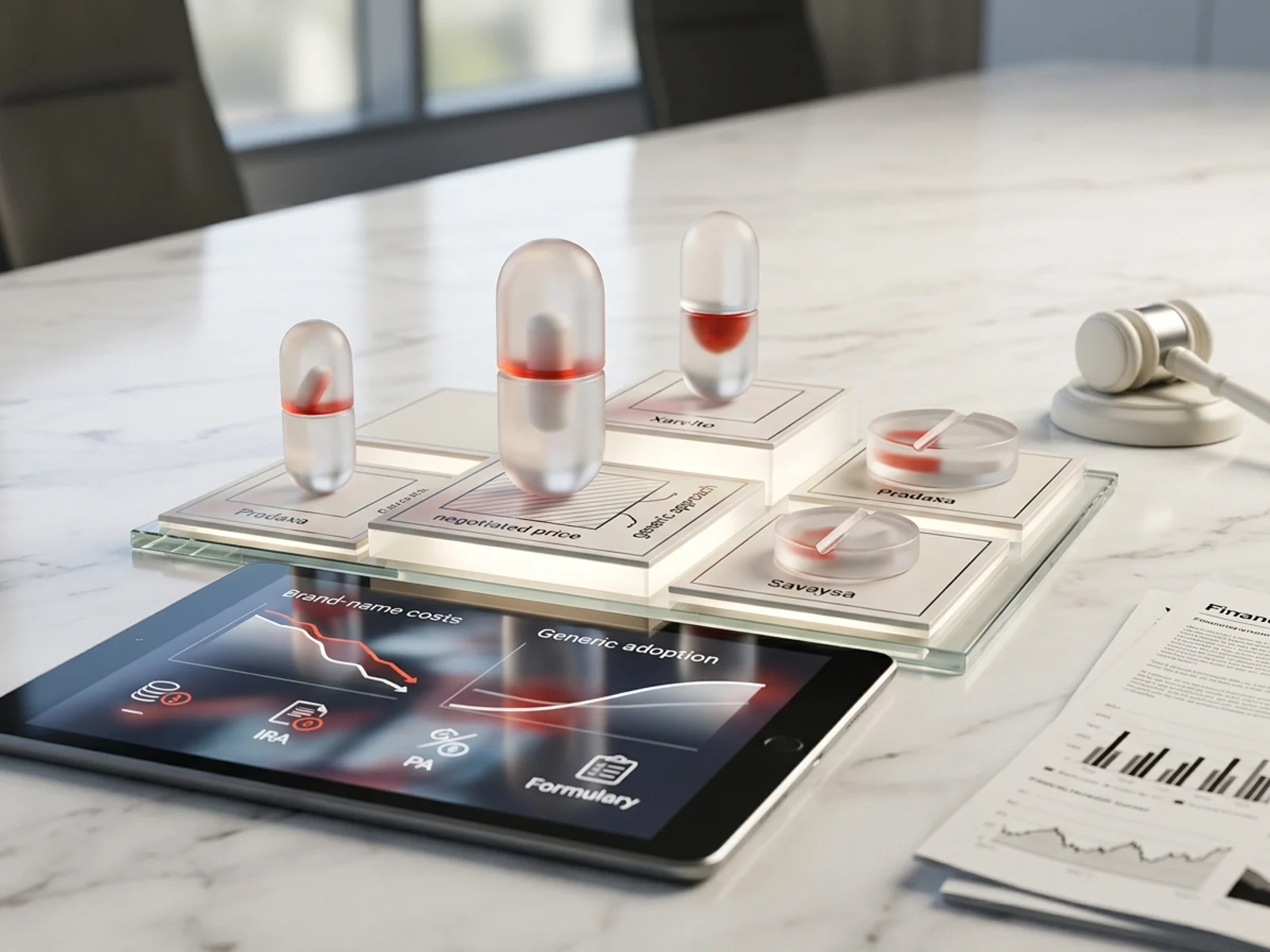
Direct oral anticoagulants (DOACs) — also called novel oral anticoagulants (NOACs) or target-specific oral anticoagulants — have largely replaced warfarin for most nonvalvular atrial fibrillation (AF) and venous thromboembolism (VTE) indications. Four DOACs are FDA-approved in the US: Eliquis (apixaban), Xarelto (rivaroxaban), Pradaxa (dabigatran), and Savaysa (edoxaban). Two of them — Eliquis and Xarelto — are among the ten drugs with IRA-negotiated Medicare prices effective in 2026, and generic competition is approaching.
This landscape guide is for prescribers, access teams, pharmacists, and payer professionals who need a cross-DOAC view of coverage, prior authorization, cost trends, and upcoming market changes.
FDA-approved DOACs at a glance
| Parameter | Eliquis | Xarelto | Pradaxa | Savaysa |
|---|---|---|---|---|
| Generic name | Apixaban | Rivaroxaban | Dabigatran etexilate | Edoxaban |
| Manufacturer | BMS / Pfizer | Janssen (J&J) | Boehringer Ingelheim | Daiichi Sankyo |
| FDA approval | Dec 2012 | Jul 2011 | Oct 2010 | Jan 2015 |
| Mechanism | Factor Xa inhibitor | Factor Xa inhibitor | Direct thrombin inhibitor | Factor Xa inhibitor |
| Dosing frequency | Twice daily | Once daily (most indications) | Twice daily | Once daily |
| Renal dosing | Yes (CrCl adjustments) | Yes (CrCl adjustments) | Yes (CrCl adjustments) | Contraindicated if CrCl > 95 mL/min (NVAF) |
| Reversal agent | Andexanet alfa (Andexxa) | Andexanet alfa (Andexxa) | Idarucizumab (Praxbind) | None |
| IRA negotiated price (2026) | Yes ($231/30-day) | Yes ($197/30-day) | No | No |
| Generic available | Not yet (expected Apr 2028) | Not yet | Yes (generic dabigatran) | No |
Common FDA-approved indications
| Indication | Eliquis | Xarelto | Pradaxa | Savaysa |
|---|---|---|---|---|
| Stroke prevention in NVAF | Yes | Yes | Yes | Yes |
| VTE treatment (DVT/PE) | Yes | Yes | Yes | Yes |
| VTE risk reduction (recurrence) | Yes | Yes | Yes | Yes |
| VTE prophylaxis post-hip replacement | Yes | Yes | No | No |
| VTE prophylaxis post-knee replacement | Yes | Yes | No | No |
| VTE prophylaxis in acutely ill medical patients | No | Yes | No | No |
| CAD/PAD risk reduction | No | Yes | No | No |
| Pediatric VTE treatment | Yes (sprinkle) | Yes (oral suspension) | Yes | No |
Formulary placement and prior authorization
DOACs are among the most widely used specialty-tier drugs in the US. Most commercial and Medicare plans cover at least one DOAC without step therapy, but prior authorization is common.
Commercial insurance
| Payer | Eliquis Tier | Xarelto Tier | PA Required | Step Therapy |
|---|---|---|---|---|
| Optum Rx / UHC | Tier 2 | Tier 2 | No (Eliquis); varies (Xarelto) | No |
| Express Scripts | Preferred | Preferred | Some plans require PA | No |
| CVS Caremark | Covered | Covered | Varies by plan | No |
| Cigna | PA required | PA required | Yes (both) | No (per Cigna policy) |
| BCBS (varies) | Tier 2 (most) | Tier 2 (most) | ~36% of plans require PA | Rarely |
| Kaiser Permanente NW | Non-formulary (step therapy required) | Preferred | Yes (Eliquis) | Yes (Eliquis requires intolerance to dabigatran + rivaroxaban) |
| Network Health | Tier 2 | Tier 2 | No | No |
A 2023 Oregon Division of Financial Regulation analysis found:
Eliquis: approximately 36.5% of plans required prior authorization; 0% required step therapy; 34.3% placed it on a non-preferred tier; no plans excluded it
Xarelto: approximately 35.5% of plans required prior authorization; 0% required step therapy; 0% placed it on a non-preferred tier; no plans excluded it
Medicare Part D
Both Eliquis and Xarelto are among the ten drugs with IRA-negotiated Medicare prices effective January 1, 2026:
| Drug | 2023 List Price (30-day) | 2026 Negotiated Price (30-day) | Discount | Part D Enrollees (2023) |
|---|---|---|---|---|
| Eliquis | $521 | $231 | 56% | ~3.7 million |
| Xarelto | $517 | $197 | 62% | ~1.3 million |
Key Medicare access points:
All Medicare Part D and Medicare Advantage drug plans must cover both Eliquis and Xarelto (IRA requirement for negotiated drugs)
The Part D out-of-pocket cap is $2,100 in 2026 (up from $2,000 in 2025)
Prior authorization may still apply but cannot result in coverage denial for FDA-approved indications of negotiated drugs
Generic dabigatran (Pradaxa) is available at lower cost tiers for patients who can use a direct thrombin inhibitor
Medicaid
State Medicaid programs generally cover DOACs with prior authorization. Common criteria include:
Documented diagnosis (AF, DVT, PE, or post-surgical prophylaxis)
Clinical rationale for DOAC selection over warfarin
Some states require trial of warfarin before covering a DOAC (though this is increasingly rare)
Pradaxa (generic dabigatran) may be placed on Tier 1 as a generic option
Generic competition timeline
The DOAC market is approaching a generational shift:
| Drug | Patent Status | Expected Generic Entry | Impact |
|---|---|---|---|
| Eliquis | Compound patent expires Nov 21, 2026; formulation patent extends to ~April 2028 | April 2028 | Will be the largest US generic launch by volume |
| Xarelto | Pediatric exclusivity extends some protections | After Eliquis (exact date pending) | Generic rivaroxaban expected after Eliquis |
| Pradaxa | Patent expired | Generic dabigatran available now | First generic DOAC on the US market |
| Savaysa | Patent active | No generic timeline | Smallest market share of the four |
The FDA approved the first generic apixaban (Eliquis) applications in December 2019, but patent settlements between BMS/Pfizer and generic manufacturers delayed US market entry to April 2028. In Europe and Canada, generic apixaban has been available since 2022, creating a significant pricing disparity with the US.
Eliquis vs. Xarelto: access differences
While both are factor Xa inhibitors and covered for most overlapping indications, there are practical access differences:
| Factor | Eliquis | Xarelto |
|---|---|---|
| Dosing | Twice daily | Once daily (most indications) |
| Formulations | Tablet, Sprinkle (pediatric), DVT/PE treatment starter pack | Tablet, oral suspension, DVT/PE treatment starter pack |
| Most common PA ICD-10 | I48.91 (unspecified AF), I82.90 (unspecified DVT), I26.9 (PE) | I48.91, I82.90, I25.10 (atherosclerotic heart disease) |
| Kaiser NW access | Non-formulary (requires intolerance to dabigatran + rivaroxaban) | Preferred |
| IRA negotiated price | $231/month | $197/month |
| Once-daily adherence advantage | No | Yes |
| Landmark trial (bleeding risk) | ARISTOTLE: lower major bleeding vs. warfarin | ROCKET-AF: non-inferior bleeding vs. warfarin |
Prior authorization checklist
When submitting prior authorization for any DOAC, prepare:
Diagnosis documentation: ICD-10 code (I48.x for AF, I82.90 for DVT, I26.9 for PE, Z96.641/Z96.642 for post-joint replacement)
Clinical rationale: Specify indication, duration of therapy, and why a DOAC is preferred over warfarin
Renal function: Current creatinine clearance (CrCl) — critical for dose selection and product eligibility
Contraindications check: Document absence of prosthetic heart valves, hemodynamically significant mitral stenosis, or other contraindications
Concurrent medications: Note antiplatelet agents, NSAIDs, or interacting drugs
Prior therapy: If applicable, document prior anticoagulant use, INR management issues, or intolerance to warfarin
Common ICD-10 codes for DOAC prior authorization:
| ICD-10 | Description |
|---|---|
| I48.0, I48.1, I48.91 | Atrial fibrillation |
| I82.90 | Unspecified deep vein thrombosis |
| I26.9, I26.90 | Pulmonary embolism |
| I25.10 | Atherosclerotic heart disease |
| Z96.641, Z96.642 | Presence of artificial hip/knee joint |
Cost and copay programs
Commercial copay programs
| Drug | Manufacturer Program | Copay | Annual Maximum |
|---|---|---|---|
| Eliquis | BMS Pfizer | As low as $10/month | Varies |
| Xarelto | Janssen | As low as $10/month | Varies |
| Pradaxa | Boehringer Ingelheim | Copay assistance | Varies |
| Generic dabigatran | Multiple manufacturers | Typically Tier 1 copay | Plan-dependent |
Patient assistance
Each manufacturer offers patient assistance programs for qualifying uninsured or underinsured patients. Income thresholds and eligibility vary. Eliquis and Xarelto programs are available through the manufacturers' respective websites.
Cash pricing (30-day supply)
| Drug | Retail Cash Price | GoodRx/SingleCare Range |
|---|---|---|
| Eliquis 5 mg (60 tablets) | ~$550-600 | ~$500+ |
| Xarelto 20 mg (30 tablets) | ~$500-550 | ~$450+ |
| Generic dabigatran 150 mg (60 capsules) | ~$200-300 | ~$150+ |
Health equity and access disparities
DOAC access is not evenly distributed across patient populations. Oregon PDAB analyses of Eliquis and Xarelto identified significant disparities:
Black, Hispanic, and American Indian/Alaska Native patients are consistently less likely than white patients to receive DOAC therapy despite comparable clinical indications for stroke prevention in AF or VTE treatment
Economically and socially marginalized patients are more likely to be managed with warfarin even when guidelines indicate DOACs could yield better outcomes
Apixaban prescriptions are more frequently rejected by payers for minority patients, suggesting formulary barriers disproportionately affect underserved populations
Provider bias, insurance formulary restrictions, and structural social determinants all contribute to these inequities
Observational data suggests apixaban has a lower risk of major and gastrointestinal bleeding compared to rivaroxaban and dabigatran, which may be particularly important for patients with limited access to monitoring or follow-up care
Access teams and payer professionals should consider these disparities when designing formulary policies and prior authorization criteria. Requiring step therapy through warfarin or imposing restrictive PA criteria may widen existing gaps.
What to monitor next
Eliquis generic entry (April 2028): The largest generic drug launch in US history by prescription volume. Payers are expected to rapidly shift formularies to generic apixaban. Prepare for tier changes and potential step therapy requirements starting in 2028
IRA second round negotiations: CMS is negotiating prices for 15 additional Part B and Part D drugs for 2028 implementation, which could include additional cardiovascular agents
CMS interoperability rule: Proposed 2026 rules would require payers to share detailed PA decision data through APIs, potentially streamlining the PA process starting October 2027
Pradaxa generic uptake: As the first generic DOAC available, dabigatran uptake patterns will signal how payers and prescribers will respond to Eliquis and Xarelto generics
New DOAC pipeline: No new DOACs are in late-stage development, but fixed-dose combinations and reversal agent improvements may affect the landscape
Medicare Part D OOP cap changes: The $2,100 cap in 2026 will significantly reduce patient costs for DOACs, particularly for Eliquis and Xarelto under negotiated prices
Disclaimer
This article is for informational purposes only and does not constitute medical advice. Coverage, formulary placement, and prior authorization criteria vary by plan and change frequently. Always verify current requirements with the patient's specific payer.
Sources
CMS. Medicare Drug Price Negotiation Program: Selected Drugs for Initial Price Applicability Year 2026. https://www.cms.gov/files/document/fact-sheet-medicare-selected-drug-negotiation-list-ipay-2026.pdf
KFF. Key Facts About Medicare Drug Price Negotiation. https://www.kff.org/medicare/key-facts-about-medicare-drug-price-negotiation
Oregon Division of Financial Regulation. Eliquis plan design analysis. https://dfr.oregon.gov/pdab/Documents/Eliquis.pdf
Oregon Division of Financial Regulation. Xarelto plan design analysis. https://dfr.oregon.gov/pdab/Documents/Xarelto.pdf
Cigna. Anticoagulants — Eliquis Prior Authorization Policy. https://static.cigna.com/assets/chcp/pdf/coveragePolicies/cnf/cnf_311_coveragepositioncriteria_%20anticoagulants_eliquis_pa.pdf
ASPE/HHS. Medicare Prices Negotiated for 2026 Compared to List and US Net Prices. https://aspe.hhs.gov/reports/medicare-prices-negotiated-2026
FDA. First Generic Drug Approvals. https://www.fda.gov/drugs/drug-and-biologic-approval-and-ind-activity-reports/first-generic-drug-approvals
Drugs.com. Generic Eliquis Availability. https://www.drugs.com/availability/generic-eliquis.html
PrescriberPoint. Eliquis and Xarelto prior authorization resources. https://prescriberpoint.com/therapies/eliquis-e948162/prior-authorization-forms
AJMC. Biosimilar Interchangeability and Substitution in the US. https://www.ajmc.com/view/biosimilar-interchangeability-and-substitution-in-the-us-what-comes-next-