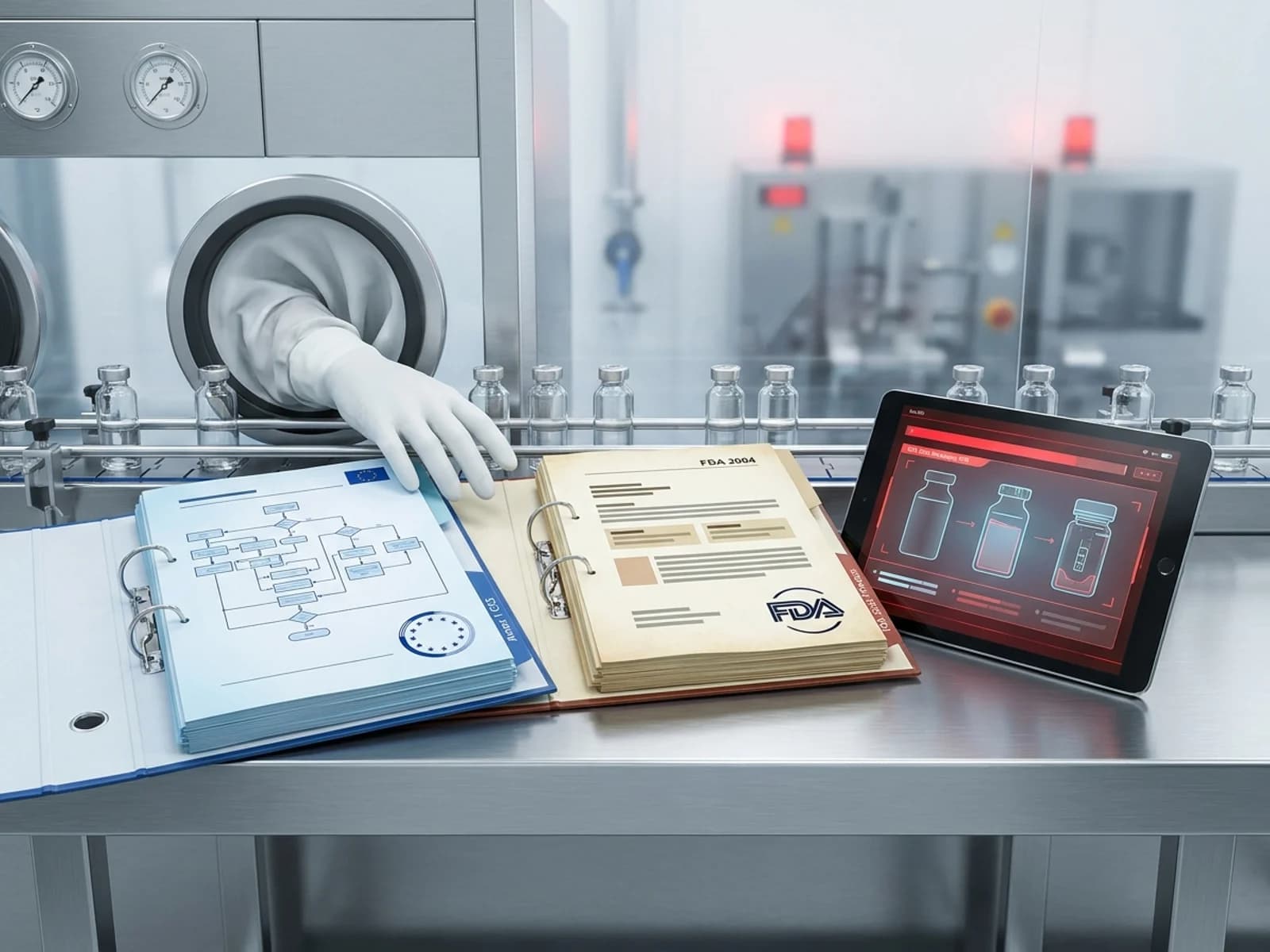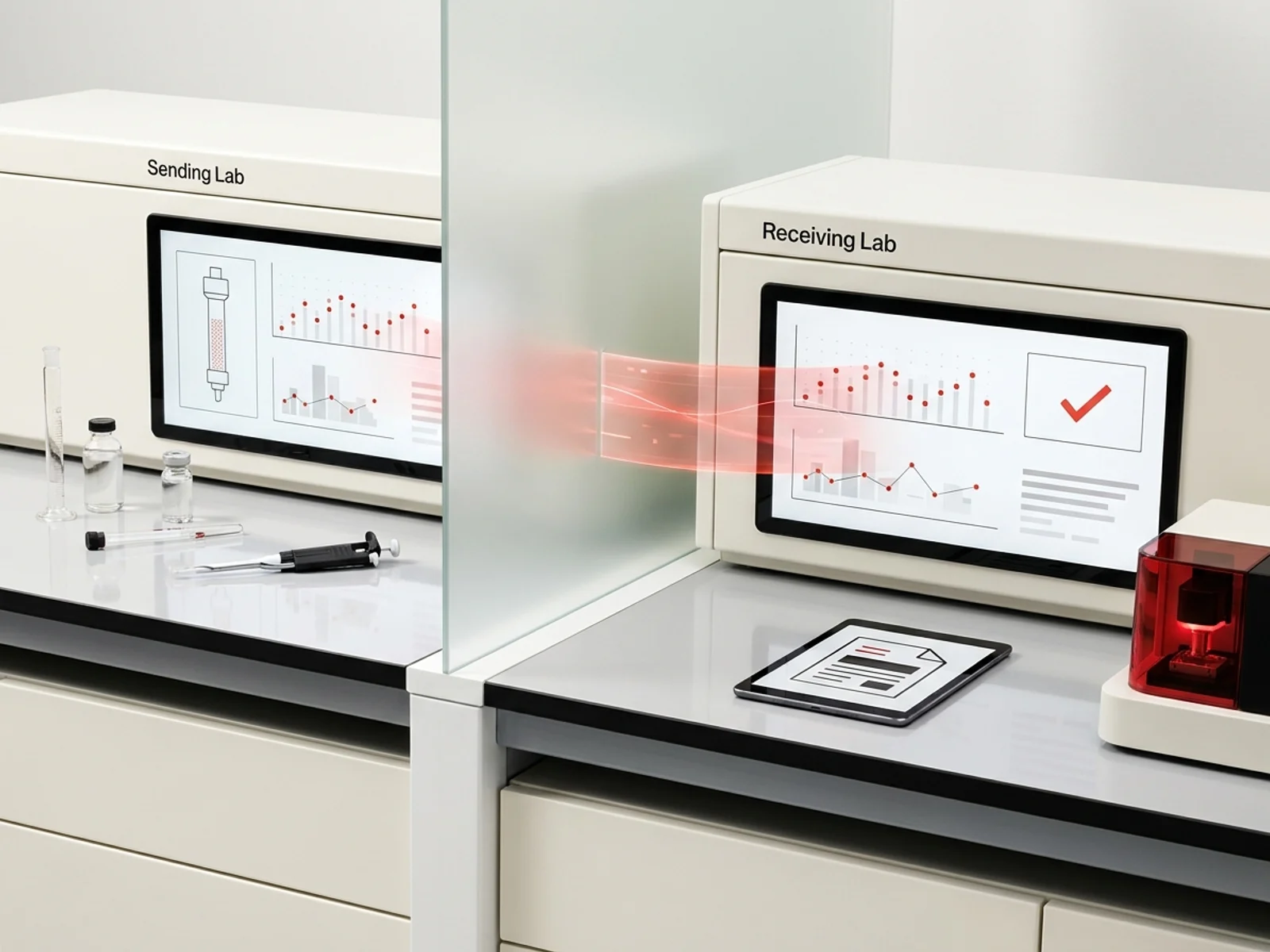
Moving a validated analytical method from a development or sending laboratory (SL) to a new commercial release-testing laboratory (RL) is a documented qualification exercise governed by USP <1224>, ICH Q2(R2), and FDA's guidance on Analytical Procedures and Methods Validation for Drugs and Biologics. The acceptance criteria in the transfer protocol are the binding decision point: too loose and a real inter-lab difference goes undetected; too tight and the transfer fails on statistical noise rather than a meaningful performance gap.
This article focuses on how to set, justify, and defend those criteria — the operational problem that causes the most avoidable delays, retests, and regulatory questions during a method transfer for commercial release testing.
Why Acceptance Criteria Fail in Practice
FDA's guidance states that analytical procedures "should be described in sufficient detail to allow a competent analyst to reproduce the necessary conditions and obtain results within the proposed acceptance criteria." In practice, three recurring mistakes cause transfers to fail or produce ambiguous results:
Arbitrary criteria detached from historical performance. Setting assay acceptance at 98.0–102.0% because that is a common specification range, without checking whether the sending lab's own intermediate precision actually supports that band, creates false failures. The Contract Pharma best-practice survey on analytical method transfers identifies arbitrary acceptance criteria as a primary driver of transfers that pass from a practical standpoint but fail on paper, and vice versa.
Ignoring method-specific variability. A bioassay with 8% intermediate precision cannot meet a 2% difference-in-means criterion that would be appropriate for an HPLC assay. USP <1224> explicitly states that acceptance criteria "should be based on method performance and historical data from stability and release results, if available."
Conflating specification limits with transfer criteria. Product specifications define whether a batch is releasable. Transfer criteria define whether the RL can reproduce the SL's method performance. These are distinct statistical questions. A method can produce results within specification at both labs while still showing a systematic bias between them that a transfer protocol should catch.
The Four Transfer Strategies and When Each Applies
USP <1224> and ICH Q2(R2) recognize four transfer approaches. The choice of strategy determines what acceptance criteria look like.
Comparative Testing
Both SL and RL test identical samples using the same procedure, and results are compared against pre-defined criteria. This is the most common approach for commercial release methods.
FDA's guidance recommends comparative studies that "evaluate accuracy and precision" and "assess inter-laboratory variability across originating and receiving laboratories." For stability-indicating methods, both sites analyze forced degradation samples or samples containing pertinent product-related impurities.
Typical design: at least two analysts at each lab independently analyze three lots of product in triplicate (18 executions total per ISPE recommendations). Acceptance criteria compare means and variability between sites.
Co-Validation
The RL participates in the original method validation as a co-validation site. Data from both laboratories are combined to demonstrate that the method meets predefined performance criteria at multiple sites. Per ICH Q2(R2), co-validation "can be used to demonstrate that the analytical procedure meets predefined performance criteria by using data generated at multiple sites and could also satisfy the requirements of analytical procedure transfer at the participating sites."
Pharmaceutical Technology's case study on breakthrough-therapy covalidation showed that co-validation reduced the proportion of methods requiring separate comparative testing to 17%, with documentation streamlined by incorporating procedures, materials, acceptance criteria, and results directly into validation protocols and reports — eliminating separate transfer protocols.
Revalidation or Partial Revalidation
The RL performs full or partial validation per ICH Q2 criteria. Used when the validation status is insufficient, no suitable samples are available (e.g., cleaning validation limit tests), or the method has been modified.
Transfer Waiver
No formal transfer testing is performed. Requires documented scientific justification, such as: the RL already uses the same compendial procedure, the method is pharmacopeial and verification per USP <1226> is sufficient, or the RL has extensive prior experience with an identical method. Transfer waivers are rare for commercial release methods and attract regulatory scrutiny if not well justified.
Setting Acceptance Criteria: A Structured Approach
Step 1 — Review SL Historical Performance Data
Before writing the protocol, compile the SL's intermediate precision data from validation, release, and stability testing. Key statistics to extract:
Mean result and %RSD for assay, related substances, and any critical quality attributes
Range of results across analysts, days, and instruments
Known method sensitivity to specific parameters (column age, mobile phase preparation, detector wavelength tolerance)
The APV Mainz position paper on Transfer of Analytical Procedures recommends a risk-based classification: "less critical methods" (water, residual solvents, ions) use a basic design with direct comparison, while "critical or complex methods" (LC/GC assay and related substances) require an intermediate design with two or more series and equivalence testing.
Step 2 — Select the Statistical Framework
Two frameworks dominate:
Equivalence testing (TOST — two one-sided tests). The preferred approach per ASTM E2935 and increasingly cited in FDA guidance. You define an equivalence margin (delta) — the largest difference between SL and RL means that is still practically acceptable — and test whether the observed difference falls within that margin with 95% confidence. The equivalence margin should be derived from the method's intermediate precision, not from the product specification.
Direct comparison with tolerance intervals. The RL's individual results must fall within a pre-defined range (e.g., SL mean ± 2 standard deviations). Simpler but less statistically rigorous; appropriate for less critical methods.
Per the BioProcess International method transfer review, "If criteria are too wide, a real difference between both laboratories might not be detected. If criteria are too narrow, issues might be detected that do not affect practical results for a method."
Step 3 — Derive Numeric Criteria from Validation Data
For assay methods:
| Parameter | Typical Range | Derivation |
|---|---|---|
| Difference in means (SL vs RL) | ≤ 2.0% for HPLC assay; ≤ 3.0% for bioassay | Based on intermediate precision from validation; should be no wider than the method's demonstrated capability |
| %RSD at RL | ≤ 2.0% for HPLC assay; ≤ 5.0% for bioassay | Should meet or exceed SL's intermediate precision |
| Individual results | All within specification | Floor requirement, not a transfer criterion per se |
For impurity methods:
| Parameter | Typical Approach |
|---|---|
| Known impurities at ≥ 0.1% | RL %RSD and mean should be comparable to SL within ± 25% relative difference |
| Impurities below ICH reporting threshold | Verification of detection capability; quantitative transfer criteria may not be meaningful |
| Relative response factors | Must be independently verified at RL; do not assume SL RRFs transfer automatically |
For the BioPharm International acceptance criteria framework, the recommended approach uses tolerance-based criteria: repeatability as a percentage of tolerance should be ≤ 25%, and bias should be ≤ 10% of tolerance. For bioassays, repeatability tolerance is ≤ 50%.
Step 4 — Document the Justification
The transfer protocol must include a written justification for every acceptance criterion. The FDA guidance on analytical method transfer studies states that transfer studies are "typically managed under a transfer protocol that details the parameters to be evaluated in addition to the predetermined acceptance criteria." The protocol is a controlled GMP document. Inspectors from FDA and other agencies will review whether criteria were pre-defined (not post-hoc), statistically justified, and aligned with the method's validation profile.
Common Operational Pitfalls
Equipment and column differences. HPLC column lots, detector firmware versions, and autosampler designs can introduce systematic bias. The protocol should specify whether column lot matching is required or whether the transfer explicitly tests across lots.
Relative response factor transfer. When transferring an impurity method that relies on relative response factors, Contract Pharma identifies RRF non-transferability as a specific failure mode: "Do not assume that RRFs will be the same between laboratories. Always verify the RRFs at the RU."
Sample stability during shipment. If samples are shipped between sites, degradation during transit can cause apparent inter-lab differences. The protocol should include sample integrity verification at the RL.
Solution stability and mobile phase preparation. Differences in how mobile phases are prepared (volumetric vs gravimetric), filtered, and degassed can shift retention times and resolution. Include a preparation procedure in the transfer package or test whether the RL's preparation yields equivalent system suitability.
Analyst training and qualification. USP <1224> recommends at least two analysts at the RL because "more than one analyst is required to compare intermediate precision at the two laboratories." The BioProcess International review emphasizes that "the intent of an analytical method transfer is to demonstrate suitability of a laboratory and not specific analysts."
The Transfer Report
When acceptance criteria are met, the transfer report documents:
Summary of all results from SL and RL
Statistical comparison (equivalence test results, confidence intervals, %RSD)
Evaluation against each pre-defined acceptance criterion
Deviations and investigations (if any)
Conclusion that the RL is qualified to perform the method
Per FDA guidance, "A method transfer is considered successful when the required acceptance criteria are met by both TL and RL." The report must include "the results of the transfer study, statistical analysis if appropriate, and a statement of the acceptability of the receiving laboratory to perform the analytical method."
If acceptance criteria are not met, the report must document the investigation, root cause analysis, and corrective actions before a re-transfer attempt. Failed transfers with inadequate investigation are a recurring FDA observation in warning letters related to laboratory controls.
The Lifecycle Connection: ICH Q2(R2) and Method Transfer
The 2023 ICH Q2(R2) revision integrates method transfer into the broader analytical procedure lifecycle. Under the lifecycle model, transfer is not a one-time event but a transition point where the RL takes ongoing responsibility for method performance monitoring. The ZONTAL roadmap for ICH Q14, ICH Q2(R2), and USP alignment identifies "Transfer First-Pass Success" — the percentage of transfers meeting acceptance criteria without remediation — as a key performance indicator under USP <1224>.
For CMC teams planning commercial launches, this means building transfer readiness into the validation strategy from the start: collecting the intermediate precision data that will later justify acceptance criteria, documenting method robustness across the parameter space the RL is likely to encounter, and ensuring the transfer package includes everything an RL analyst needs — not just the method procedure, but the tacit knowledge about mobile phase preparation timing, column equilibration behavior, and integration decisions that make the difference between a clean transfer and a three-month investigation.
Sources
FDA. Analytical Procedures and Methods Validation for Drugs and Biologics: Guidance for Industry. https://www.fda.gov/files/drugs/published/Analytical-Procedures-and-Methods-Validation-for-Drugs-and-Biologics.pdf
USP <1224>. Transfer of Analytical Procedures. United States Pharmacopeia.
ICH Q2(R2). Validation of Analytical Procedures. 2023. https://database.ich.org/sites/default/files/ICH_Q2(R2)_Guideline_2023_1130.pdf
BioProcess International. Methods on the Move: Addressing Method Transfer Challenges for the Biopharmaceutical Industry. https://www.bioprocessintl.com/cmc-forums/methods-on-the-move-addressing-method-transfer-challenges-for-the-biopharmaceutical-industry
Contract Pharma. Analytical Method Transfer Best Practices. https://www.contractpharma.com/analytical-method-transfer-best-practices
BioPharm International. Establishing Acceptance Criteria for Analytical Methods. https://www.biopharminternational.com/view/establishing-acceptance-criteria-analytical-methods
BioPharm International. Streamlining Method Transfer Across Global Sites. https://www.biopharminternational.com/view/streamlining-method-transfer-across-global-sites
Pharmaceutical Technology. Covalidation Strategies to Accelerate Analytical Method Transfer for Breakthrough Therapies. https://www.pharmtech.com/view/covalidation-strategies-accelerate-analytical-method-transfer-breakthrough-therapies
APV Mainz. Transfer of Analytical Procedures: Position Paper. https://www.apv-mainz.de/fileadmin/dateiablage/apv-mainz/Publikationen/Pos.papier_027gs-1.pdf
ASTM E2935. Standard Practice for Conducting Equivalence Testing in Laboratory Applications.